


Private: News
Printing on caps, overlays, and closures. Which technology should you choose?

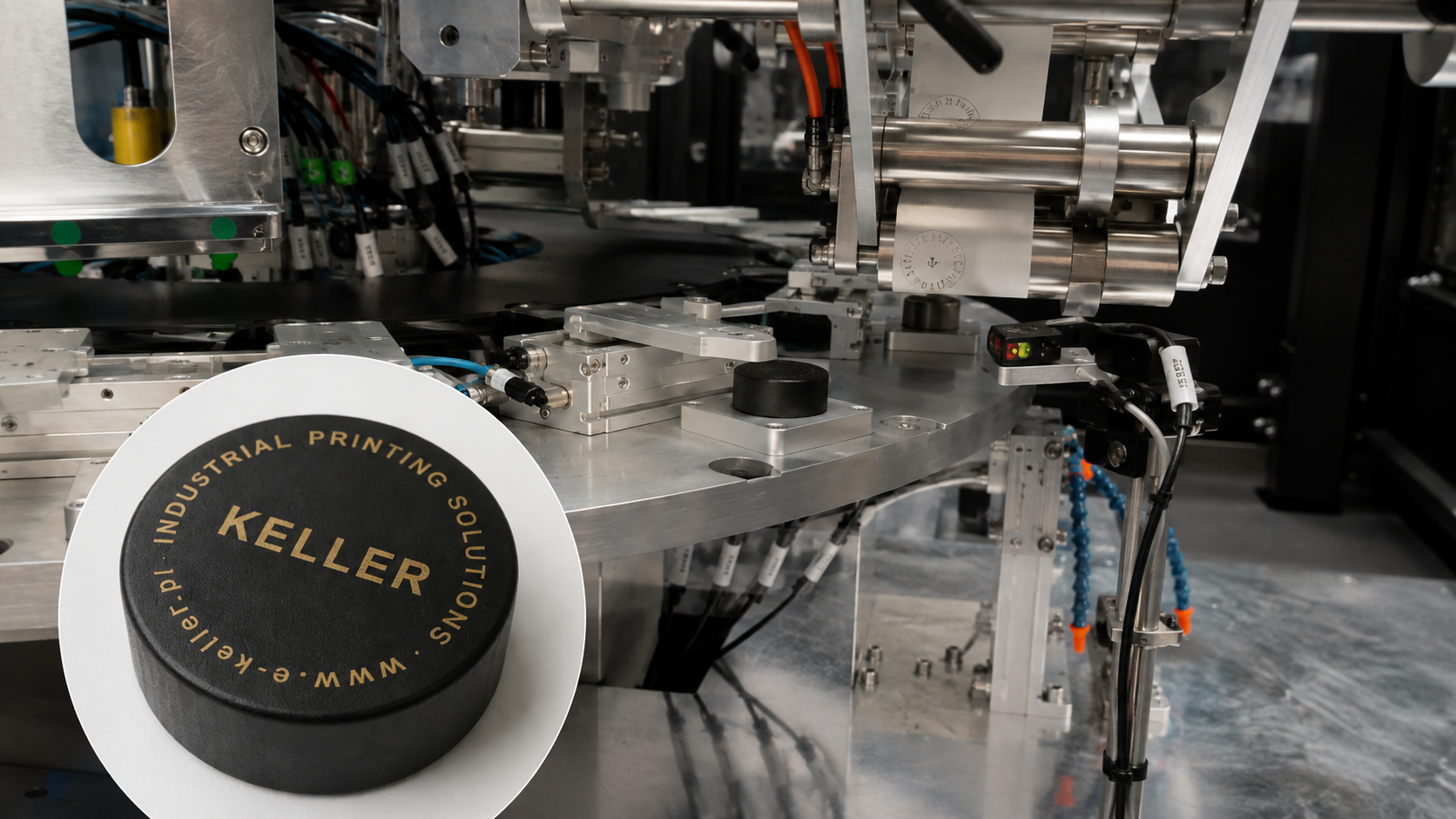
Caps, crown caps, stoppers, and overlays are small details, but printing them can be challenging. The surface is often limited, rounded, slightly convex, or made of a material that requires careful preparation and the right technology. Furthermore, repeatability is key. In mass production, simply printing a single correct print isn't enough. The same effect must be maintained across hundreds, thousands, or even millions of components.
Printing on caps can serve a variety of functions. Sometimes it's a brand logo, sometimes a series designation, a technical symbol, a decorative element, or a way to distinguish a product on the shelf. Different technologies are used for simple labeling, different ones for a premium effect, and yet different ones for prints that must be highly visible and resistant to further handling.
What influences the choice of closure printing technology?
Before choosing a method, it's worth considering a few things: the shape of the cap, crown, or stopper, the printing location, the material, the size of the print area, the expected durability, the number of colors, and the method of feeding the part into the machine. It's also important to consider whether the cap marking will be performed on the top surface, the side, the rim, or a selected section of the closure.
In practice, the printing technology itself is only part of the decision. Equally important are the part's mounting, orientation, transport, positioning, and post-printing collection. With small elements, even a slight misalignment can be noticeable, especially when the print includes a logo, lettering, symbol, or graphic sign.
Therefore, a well-designed process should take into account not only the visual effect, but also the production rhythm, ease of changeover and stability of work in subsequent series.
Pad printing on closures. When does it work best?
Pad printing on caps and closure lids is one of the most frequently chosen technologies for small and medium-sized print areas. It is particularly effective when the surface is not perfectly flat: slightly convex, concave, rounded, or difficult to access. The ink is transferred from the matrix to the component using a flexible silicone pad that conforms to the surface's shape.
Pad printing machines They are ideal for applying logos, symbols, technical markings, identification marks, and simple graphics. Pad printing can be used on plastic caps, crown caps, overlays, corks, and other small closures.
The greatest advantage of this technology is its precision in small details. With the right pad, matrix, ink, and tooling, you can achieve repeatable printing even on elements with more demanding geometries. Therefore, pad printing is well-suited for mass production, where stable positioning and legibility of markings are essential.
Hot stamping on caps, stoppers and overlays
Hot stamping is a marking and decoration technology in which foil is transferred to a surface under the influence of temperature and pressure. In the case of caps, stoppers, and overlays, it is most often chosen when the print not only conveys information but also enhances the product's aesthetics.
Hot stamping machines They work well for cosmetic packaging, premium products, decorative closures, and brand-defining elements. They can achieve gold, silver, gloss, metallic finishes, or elegant graphic details. Hot stamping works well on its own or can complement other technologies. For example, the closure can be pad-printed, and selected logo elements can be additionally enhanced with foil.
In this technology, the selection of foil, matrix, temperature, pressure and method of guiding the detail is very important.
Is screen printing applicable to caps and bottle caps?
Screen printing can be used for caps, crown caps, and closures, but it's not always the first choice. It works best when the print area is larger, easily accessible, and can be guided stably through the machine. It can be a good solution for larger closures, flat surfaces, or cylindrical elements that allow for repeatable printing.
The advantages of screen printing include good coverage, vivid color, and the ability to create a durable print over a larger area. However, for very small, irregular, or difficult-to-reach details, pad printing may be more practical. Therefore, screen printing shouldn't be ruled out, but it should be assessed in relation to the specific shape, print location, and production requirements.
Printing on caps, corks, and screw caps. Application examples.
Printing on plastic caps can include a brand logo, product designation, color variant, technical symbol, or visual identification element. Such closures are used in the cosmetics, food, chemical, and technical industries, among others.
Printing on bottle caps is often decorative or identifying. It can be applied to the top surface of the cap, a section of it, or a specific area that must be precisely aligned with the machine. Depending on the material, pad printing, hot stamping, or screen printing may be considered.
Printing on caps and lids is most often associated with branding, product series, or a premium effect. In such applications, aesthetics are crucial, as is consistency. The print on closures must appear consistent throughout the entire series, regardless of minor differences in shape or presentation.
How to choose technology for closing?
Pad printing It's a good choice when the print is small, the surface is rounded or irregular, and the goal is to apply a logo, symbol, technical marking, or simple graphics. This is a good technology for caps, crown caps, and overlays that require precise detail and repeatability in mass production.
Hot stamping It's a better choice when you want a more premium look. It works well with gold, silver, and gloss plating, and adds decorative distinction to your product. It's worth considering for cosmetic packaging, gift products, and closures designed to enhance brand recognition.
Screen printing It's worth considering when the print area is larger, strong coverage is needed, and the detail can be stably guided through the process. It can be a good choice for larger closures or items where the print will cover a wider area.
It's not always possible to choose the right method on your own. In practice, you need to consider the material, geometry, print location, expected durability, number of colors, detailing method, and production requirements.
If you're unsure which technology is right for your product, contact Keller. Our specialists will analyze the detail, material, and process, and then help you select the marking method and machine best suited to your production conditions.
Accurate printing on closures
Printing on caps, crown caps, stoppers, and overlays requires matching the technology to the print's shape, material, and function. Pad printing works well on smaller and more difficult surfaces, hot stamping for decoration and a premium effect, and screen printing can be a good solution for larger print areas and stable detail tracking.