


Private: News
UV printing – what is it and how is it used in industrial printing?

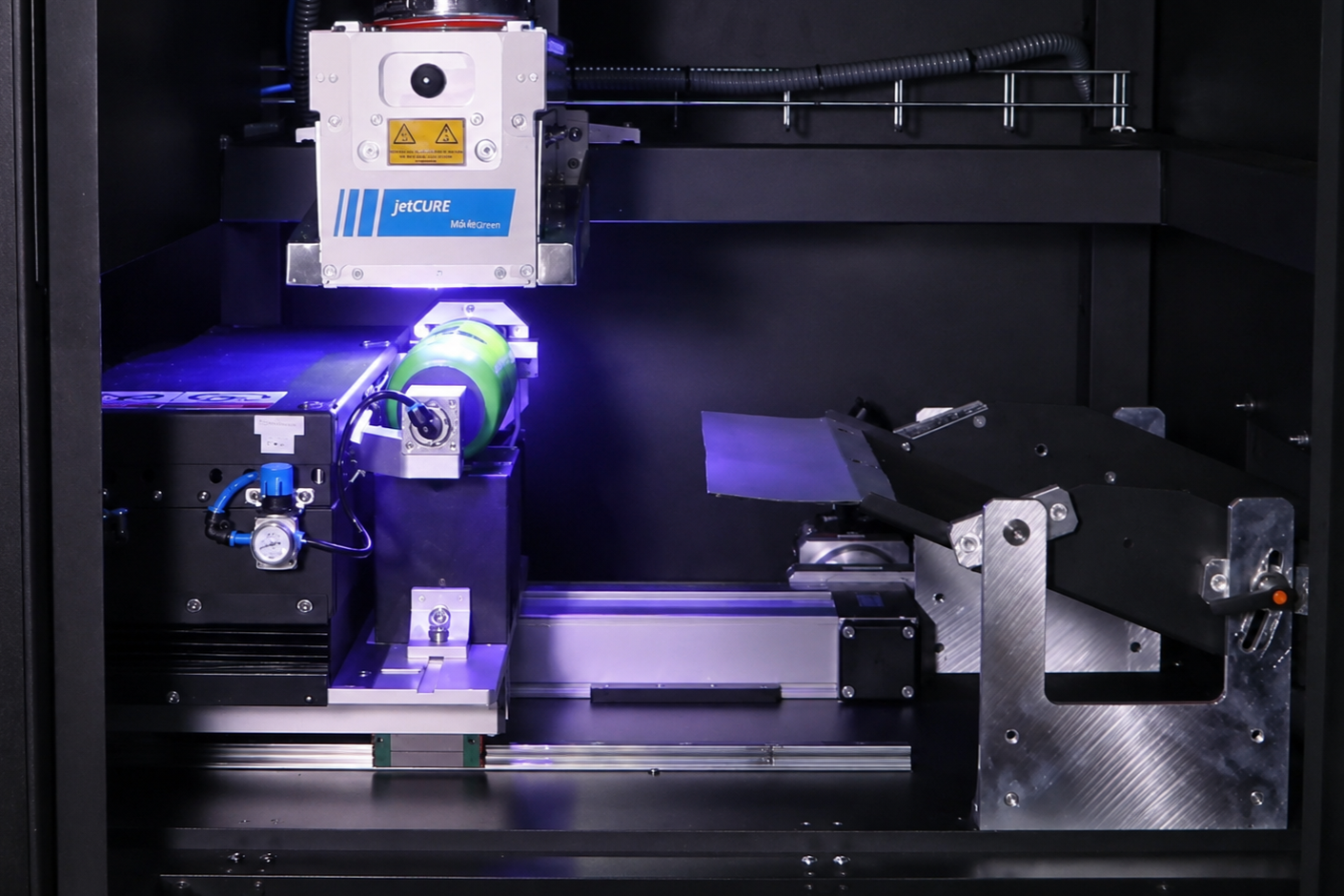
UV printing is often associated with digital UV printers, which apply special UV inks directly to the material's surface and then immediately cure them with ultraviolet light. However, this is just one application of this technology.
In industrial printing, UV inks are also used in screen printing and pad printing. In these cases, the method of ink application is different, but the principle of curing remains similar – the print is hardened using UV radiation.
The answer to the question what UV printing is is therefore broader: it is a group of printing processes using paints or inks that, after being applied to the substrate, are hardened by ultraviolet radiation.. The UV printing technology itself does not have to be digital.
What is UV printing and ink curing?
In traditional ink systems, curing may require solvent evaporation, a chemical reaction, or exposure to heat. However, with UV inks, the process is different.
After applying the paint to the surface, the part passes through a UV or UV LED lamp. The radiation initiates a photochemical reaction that rapidly hardens the paint layer.
Thanks to this UV curing This can occur immediately after printing. This is particularly important in mass production, where the part can quickly move on to the next printing station, quality control, or production step.
Special UV inks are used in digital printing., sometimes also referred to as polymer inks. They contain, among other things, reactive monomers, oligomers, and photoinitiators. Under the influence of UV radiation, a polymerization reaction occurs, resulting in the liquid ink quickly forming a hardened layer on the material's surface.
In screen printing and pad printing However, specialized UV paints are used, adapted both to the application technology and the material on which the print is made.
UV printing is not just digital printing
Digital UV printing is currently very popular in advertising production, among other industries. The printer applies ink directly from a graphic file, without the need for screen or matrix preparation. This solution works well for small runs, variable graphics, and personalization.
However, other methods are also used in industrial production.
UV screen printing
In screen printing, the ink is pressed with a squeegee through a properly prepared screen and then hardened with UV radiation.
This technology allows for controlled paint application and good coverage. It can be used on both flat surfaces and properly guided three-dimensional or cylindrical details.
UV screen printing is used, among others, for printing on packaging, panels, industrial components, plastics, glass and painted surfaces.
UV pad printing
In pad printing, the ink is drawn from the matrix through a flexible silicone pad, which then transfers the print to the component. After printing, the ink can be UV-cured.
Pad printing works well on small components and on curved, convex, concave, and irregular surfaces. It can be used to mark buttons, knobs, technical components, and small housing components.
A typical example could also be UV printing on gadgets, such as promotional pens with a company logo. The small footprint and cylindrical shape of such a product clearly demonstrate why, in certain applications, pad printing can be more practical than digital printing or screen printing.
UV digital printing or screen printing and UV pad printing?
The choice of technology should depend primarily on the detail and production volume.
UV digital printing offers a significant advantage for short runs. It doesn't require screen or matrix preparation, so production can begin quickly, and changing graphics doesn't require preparing a new printing plate.
With large volumes the situation may be different. Screen printing and pad printing require advance process preparation, but this cost is then spread across a large number of products. Properly designed and automated screen printing machine can work with high repeatability and efficiency, thanks to which the cost of making a single print decreases as the series increases.
Therefore, in industrial production the question should not be: digital printing or UV printing?
Screen printing and pad printing can also utilize UV curing. The real question is: What method of applying UV paint will be most suitable for a specific product, material, graphics and expected production volume?
UV printing on glass, metal, PVC and other materials
One of the key advantages of UV technology is its ability to print on a wide variety of substrates. However, this doesn't mean that one ink is suitable for every material.
Depending on the appropriately selected paint system, it is possible to:
- UV printing on glass,
- UV printing on metal,
- UV printing on PVC,
- printing on PET and PETG,
- printing on PP and PE,
- printing on PC and PMMA,
- print on ABS,
- printing on varnished surfaces,
- printing on paper and cardboard.
It is also possible UV printing on wood, however, in industrial applications the type of surface, its preparation and paint adhesion requirements must be taken into account.
The material has a direct impact on paint selection. For example, a system designed for glass must meet different requirements than a paint for flexible plastic or a PP component.
How to choose UV paint for the material?
UV inks are selected not only based on color. Consideration must be given to the substrate material and the conditions in which the printed item will be exposed.
The following may be of importance, among others:
- adhesion to a specific material,
- abrasion resistance,
- resistance to water and moisture,
- resistance to alcohol and chemicals,
- flexibility,
- required degree of coverage,
- glossy or matte,
- resistance to subsequent technological processes.
For some materials, surface preparation is also necessary before printing. This may include cleaning and degreasing, and for more difficult materials, surface activation.
Keller offers specialized UV inks for screen printing and pad printing, selected for the material and specific process requirements.
A separate group is UV varnishIn industrial printing, it can be used to protect surfaces or create specific effects, such as gloss, matte, or a 3D convex layer.
Advantages of UV printing
The most important advantage is the rapid curing of the print. A properly designed process allows for a reduction in the time between printing and subsequent production stages.
Depending on the ink used, UV printing can also provide:
- high abrasion resistance,
- resistance to moisture and water,
- chemical resistance,
- high coverage,
- good adhesion to certain materials,
- stability in serial production,
- high gloss or other surface effects,
- the ability to quickly apply subsequent colors.
In screen printing and pad printing, an additional significant advantage is the ability to combine the properties of UV inks with the efficiency of the process designed for large series.
What are the limitations of UV printing?
UV printing is not a universal and unconditional technology.
First and foremost, the ink must be properly matched to the material. An inappropriate ink system can cause problems with adhesion, durability, or print resistance.
The process also requires an appropriate curing system and control of its parameters. These factors include the type of UV source, radiation dose, part travel speed, and the properties of the applied layer.
Some substrates require prior surface preparation, and technological trials may be necessary for new materials or particularly demanding applications.
The choice of ink application method should also be based on process economics. UV digital printing can be very beneficial for short and variable production runs, but it won't always be the most economical solution for hundreds of thousands of identical components.
UV printing machine in industrial production
UV printing machine doesn't necessarily mean a digital UV printer. In industry, it can also mean a screen printing or pad printing machine equipped with an appropriate curing system.
The process may include the following steps:
surface preparation -> detail positioning -> paint application -> UV curing -> next color -> re-curing -> quality control.
Keller designs machines for a specific product, material and intended production cycle. The design may include:
- dedicated mounting devices,
- automatic feeding of parts,
- several printing stations,
- UV systems,
- possibility of retooling the machine for subsequent product variants.
In addition to machine design and construction, Keller also offers UV inks for screen printing i pad printing inksThis allows the application technology, curing system, and paint to be selected as components of a single process, rather than being treated as independent parts of production.