


Print on glass
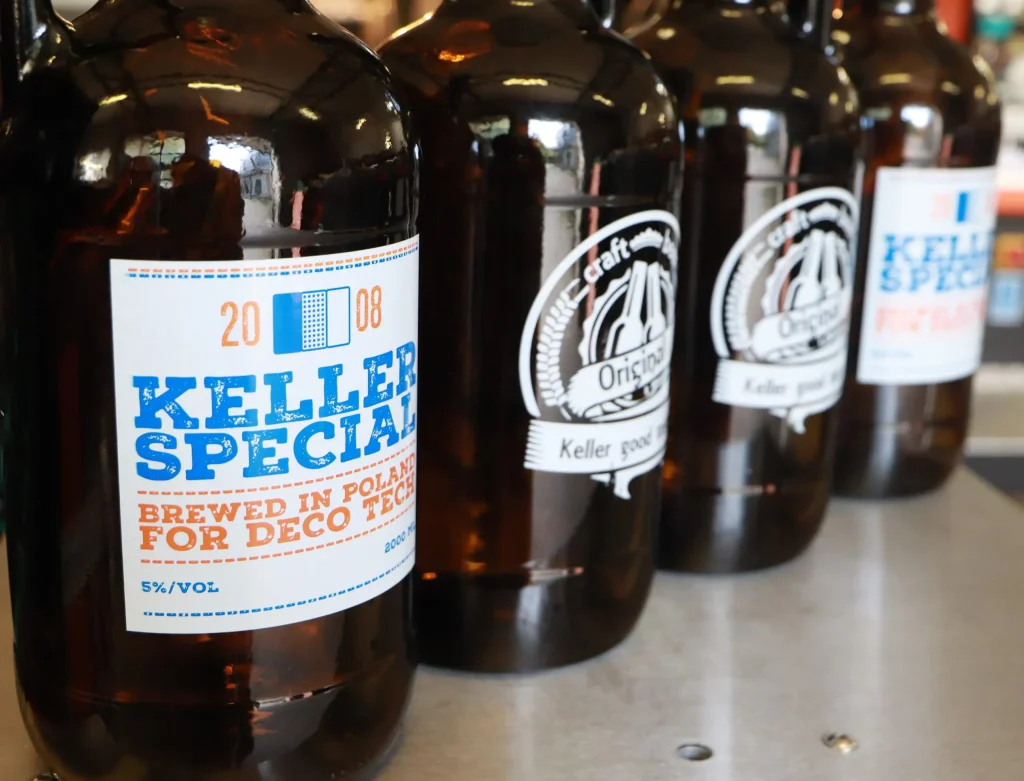
Printing on glass. Hot stamping, screen printing, or pad printing?
Glass is a challenging material to mark and decorate. It has a smooth, non-absorbent surface, comes in a variety of shapes, and often serves aesthetic, functional, or technical purposes. Therefore, when choosing a printing technology, it's not enough to simply ask whether it's possible to print on glass. The method must be selected based on the type of glass, the shape of the detail, the desired effect, the print's durability, and the entire production process.
At Keller, we design glass printing machines for specific applications. We consider not only the material but also the product geometry, the method of part feeding and unloading, the required throughput, the number of colors, the type of ink or foil, and the machine's operating conditions in production. Depending on your needs, we can use screen printing on glass, pad printing on glass, or hot stamping on glass.
Screen printing on glass
Screen printing on glass is ideal for applications requiring a durable, clear, and repeatable print. This technology involves applying ink directly to the glass surface through a prepared screen. It can be used for bottles, vials, cosmetic packaging, glass panels, decorative elements, and technical details, among other applications.
The greatest advantage of screen printing is its excellent coverage and the ability to achieve intense colors and precise contours. With the right ink, surface preparation, and curing process, the print can be resistant to abrasion, moisture, and wear and tear. This is especially important in the cosmetics, packaging, and industrial industries, where glass is often processed, packaged, transported, or subjected to intensive use.
Screen printing works well on both flat and cylindrical surfaces. For bottles or flasks, it's crucial to precisely synchronize the movement of the detail with the operation of the screen and squeegee. Check out our post where we discussed this in more detail – UV screen printing on glass.
Pad printing on glass
Pad printing on glass is a good solution for details with more difficult shapes, smaller print areas, or areas that may be difficult to access with traditional screen printing. In this technology, ink is picked up from a matrix and transferred to the glass using a flexible silicone pad.
The biggest advantage pad printing machines It is possible to print on irregular, slightly convex, concave, rounded, or hard-to-reach surfaces. This makes the technology suitable for marking small glass elements, technical markings, logos, symbols, scales, inscriptions, and details that do not have a perfectly flat surface.
Pad printing allows for precise printing on a limited surface while maintaining good process repeatability. In practice, the selection of the pad, ink, matrix, and operating parameters is crucial. The pad must be adapted to the shape of the part to properly transfer the design onto the glass without deformation or loss of quality.
Hot stamping on glass
Hot stamping on glass is used when the print is primarily intended to be decorative, premium, or to distinguish the product. The technology utilizes foil, temperature, pressure, and a specially prepared matrix. As a result, metallic, shimmering, or colored decorations can be applied to the glass surface.
Hot stamping works well on cosmetic packaging, perfume bottles, premium bottles, decorative elements, and products where appearance is crucial for sales. It allows for the creation of gold, silver, or other finishes that are difficult to achieve with traditional printing methods.
In this technology, it's crucial to match the pressure, temperature, foil type, and die shape to the specific surface. Glass doesn't behave like plastic or paper, so the process must be thoroughly tested and adjusted. With the right solution, hot stamping can give a product a significantly more elegant and high-quality character.
Need a glass printing machine?
- Fill out the form below and contact us
A machine tailored to the glass, shape and process
At Keller, we design glass printing machines based on specific workpieces and the actual production process. Therefore, when designing a machine, we analyze the surface shape, print location, workpiece mounting method, expected throughput, quality requirements, and the possibility of integration with other production stages. We also consider surface preparation, workpiece transport, print inspection, and drying or curing.
The result is not only an aesthetic print, but also a stable and repeatable process that reduces rejects, shortens downtime and helps maintain quality in subsequent series.
Not sure which technology to choose?
It's not always possible to determine the best method without examining the part, understanding the material, surface geometry, and production requirements. The same product may require a different approach depending on the desired durability, visual effect, number of colors, print location, and line workflow.
If you want everything perfected, contact us. Our specialists will help you select the right technology, surface preparation, machine, and process parameters for your specific detail or product.